


By comparing Smart Websites vs Traditional Websites, people are not having a discussion on design trends. Here is a question they are asking: “Which of them will actually favour growth without having to be rebuilt after every couple of years?”
In 2026, a website is not just a simple digital brochure. It influences the way that you get business, the way that you respond to inquiries, and the way customers experience your brand. It feeds your marketing. It supports your operations. Most businesses are not aware of their website’s impact on revenue.
A neat layout, a contact form and a couple of service pages were all more than sufficient at one point. That set-up worked well with many SMEs in the UK. But things have shifted. Consumers demand faster responses. Competition is sharper. Automation has become mainstream business, and there is a growing realisation that static sites are starting to limit themselves, at least in terms of performance tracking and scalability.
With AI being introduced into routine business practises, the landscape shifts once again. It becomes clear why digital growth UK businesses seek depends on speed, data, and adaptability. This is exactly where the debate around Smart Websites vs Traditional Websites becomes increasingly important, as a site that cannot evolve quickly inevitably becomes a bottleneck.
What Defines a Traditional Website?
A traditional website is typically brochure-led. It presents information about your company, services, and contact details. It may include a blog and basic SEO, but the structure is largely fixed.
Updates are manual. Data is limited to surface-level analytics. Contact forms send emails, but often do not connect to wider systems. If you want new functionality, it usually means developer time and additional cost.
For many small firms across the UK, this model has worked. A local accountancy practice, a building contractor in Manchester, or a consultancy in London might only need clear messaging and reliable hosting.
The challenge appears when growth accelerates. As enquiries increase, marketing expands, and customer journeys become more complex, a static site struggles to keep up.
What Makes a Website “Smart”?
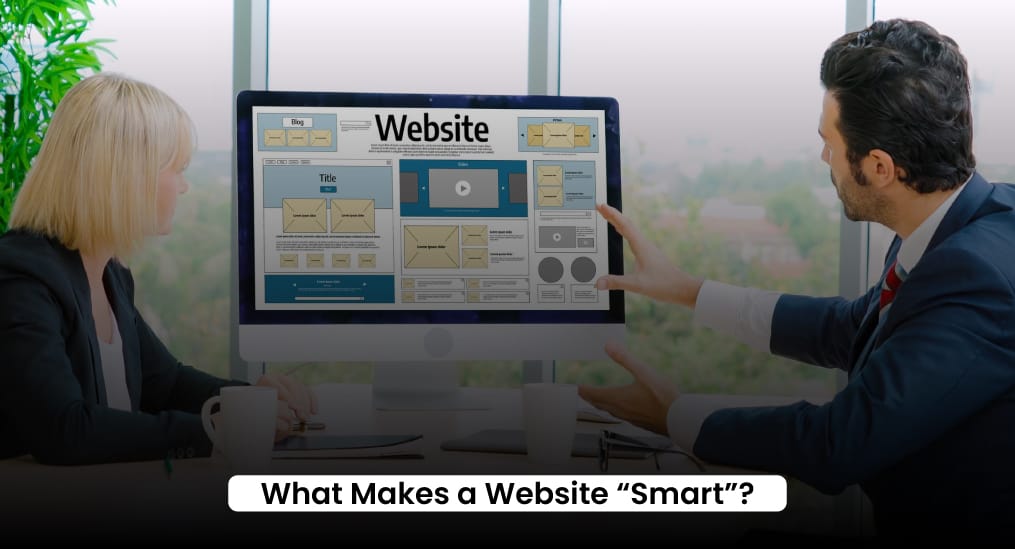
A smart website is built as part of a wider digital system. It connects to your CRM, marketing automation, analytics platforms, and customer communication tools. It collects meaningful data and responds to user behaviour.
Instead of simply displaying information, it adapts.
By integrating AI in digital marketing, smart websites can personalise content, adjust calls to action based on behaviour, and automate lead handling. For example, a returning visitor from Leeds might see different content to a first-time visitor from Bristol. A user who browses pricing pages may trigger an automated follow-up sequence.
A smart website design also supports structured data, advanced tracking, and performance monitoring that feeds directly into business decisions.
Smart Websites vs Traditional Websites: Core Differences
At a practical level, the difference between Smart Websites vs Traditional Websites comes down to capability and integration.
- Traditional sites are largely static. Smart sites are dynamic.
- Traditional sites collect limited data. Smart sites track behaviour in depth.
- Traditional sites rely on manual follow-up. Smart sites automate lead routing and nurturing.
- Traditional sites require separate tools for email, CRM, and reporting. Smart sites connect these tools into a single ecosystem.
Consider a UK e-commerce brand selling sustainable home goods. A traditional website might display products and process payments. With a smart website, supported by structured e-commerce development UK businesses can recommend their products based on browsing history, trigger abandoned basket emails automatically, and segment customers for targeted campaigns.
Performance and Scalability in the UK Market
UK markets are very competitive and regional in nature. The search patterns are different between industries and cities. A smart site can adjust itself more to these nuances.
Page speed is not the only thing regarding performance. It is also about how responsive it is to change. Will your site be capable of adjusting content, structure, and optimisation without a complete rebuild in the event that Google alters its algorithm or consumer demand changes?
When comparing AI SEO vs traditional SEO, the difference often mirrors the broader website debate. Conventional SEO is based on manual research and predetermined content approaches. AI-assisted SEO analyses trends at scale, detects opportunities more quickly and fosters ongoing optimisation.
Smart websites are created to accommodate such agility. They combine technical SEO, content planning, and performance information. It is about making decisions faster and having fewer blind spots.
Automation and Operational Efficiency

One of the clearest advantages of smart website development is automation.
Imagine a law firm in Bristol receiving 40 online enquiries a week. On a traditional site, each form submission lands in an inbox. Someone manually reviews it, forwards it, and logs it in a spreadsheet. Delays are common.
With smart website development, the form can route enquiries by case type, assign them to the correct solicitor, create a record in the CRM, and trigger a confirmation email automatically. No copying and pasting. No missed leads.
Over time, that efficiency compounds. Staff spend less time on admin and more time on billable work.
Data, Insight and Decision-Making
Traditional websites provide basic metrics: page views, bounce rate, and traffic sources.
Smart websites go further. They track behaviour patterns, conversion journeys, and engagement signals across channels.
For a UK marketing manager, this means clearer answers to everyday questions. Which campaigns generate the highest-value leads? Which pages drive real enquiries rather than casual visits? Where do prospects drop off?
When data feeds into dashboards automatically, decisions improve. Budgets are allocated more accurately. Content priorities become clearer.
In a challenging economic climate, that clarity can be the difference between steady growth and stagnation.
SEO and UK Search Behaviour in 2026
Search behaviour in the UK continues to evolve. Voice queries, AI-generated summaries, and localised results are becoming more common.
Smart websites are better positioned to support structured content, schema markup, and adaptable page architecture. This improves visibility in featured snippets and AI-driven search summaries.
Smart website design also considers mobile-first indexing, accessibility standards, and user intent from the outset. These elements are often bolted onto traditional sites later, which can limit effectiveness.
For SMEs competing in crowded sectors such as financial services, property, or online retail, technical readiness is no longer optional.
When Should a Business Move?
Not every company needs to switch immediately. The decision depends on growth stage, complexity, and ambition.
You might consider moving if:
- Lead volumes are increasing and follow-up feels inconsistent
- Marketing tools are disconnected
- Reporting requires manual compilation
- You are expanding into new UK regions
- Your team spends excessive time on repetitive digital tasks
In the wider debate around Smart Websites vs Traditional Websites, timing matters as much as technology. A stable local trades business with steady demand may manage well with a traditional setup for longer. A scaling e-commerce brand or multi-location service provider will likely outgrow it quickly.
Smart Websites vs Traditional Websites: A Strategic View
The debate around Smart Websites vs Traditional Websites is not about trends. It is about readiness.
In 2026, UK businesses face tighter competition, higher customer expectations, and more complex digital channels. A traditional website can still serve a purpose, particularly for smaller or stable operations.
However, as a UK digital partner focused on Smart Digital Solutions, the most successful projects tend to start with strategy rather than software. The conversation is rarely about features alone. It centres on operational goals, customer journeys, and long-term scalability.
An agency combining websites, automation, and AI-driven strategy looks at the entire ecosystem. The website is one component within marketing, CRM, analytics, and performance systems.
Your website should not just represent your business. It should actively support it. Many business owners are now researching the difference between a regular website and a smart website to understand how automation, data integration, and AI-driven functionality can transform performance beyond simple online presence.


