

Learning how to start selling on Amazon in 2026 is no longer just about listing products. Entrepreneurs must understand data, automation, and strategic brand positioning to compete in today’s marketplace.
The marketplace has been turned into a data-driven ecosystem where success is determined through optimized listing, automated processes, and informed brand strategy.
Sellers have to decide according to analytics, market understanding, and operational effectiveness to compete in a competitive world.
This guide is a description of a contemporary entry strategy into Amazon, focusing on the strategic aspects, AI applications, fulfillment strategies, and branding.
Choosing the Right Product When Starting to Sell on Amazon
It takes research and strategic analysis to determine what to sell on Amazon. One cannot afford to follow trends or individual preference. Effective sellers research the demand, the saturation in the market, and the profit margins upon which they base their inventory commitment.
With the help of platforms that provide AI-driven digital solutions, one can utilize historical sales data, search volume trends, and rival activity to propose profitable products. This enables businesses to know the needs of customers in advance and the areas where they can create a successful difference.
When learning how to start selling on Amazon, logistics, seasonal demand, and the possibility of bundling or complementary products are important factors to consider. Even the slightest difference, like a packaging innovation or a unique feature, can provide a competitive advantage in a very saturated market.
How to Start Selling on Amazon Step-by-Step
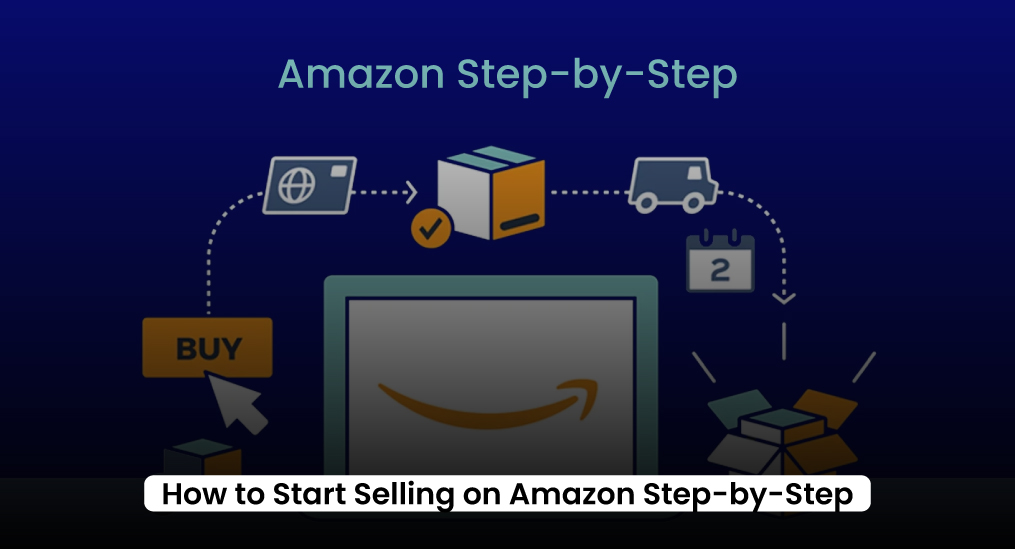
Learning how to start selling on Amazon is not just about creating accounts. The steps also involve compliance, product preparation, and fulfillment planning.
1. Create a Business Profile
Register on Amazon Seller Central and select either the professional plan if you intend to scale. Present business verification details, tax information, and bank account details.
2. Choose Fulfillment Strategy
Decide between Fulfillment by Amazon (FBA) or Fulfilled by Merchant (FBM). FBA allows Amazon to store, deliver, and provide customer support, making business operations easier and qualifying them as Prime.
3. Make Products and Inventory Ready
Assign special codes, such as UPC or FNSKU. Meet packaging standards and safety requirements.
4. Create Listings
Create conversion-oriented listings, which include high-quality images, accurate description and optimized keywords. The use of AI SEO tools assists in determining the language that customers are searching in.
5. Launch Your Store
Set up pricing, inventory policies, and shipping. The automation tools can track the stock and change the pricing dynamically to remain competitive.
6. Monitor Performance
Monitor the orders, conversion rates, and customer feedback using Seller Central analytics. Make proactive adjustments to the listing or inventory.
Collaborating with a Digital Agency may simplify this process, particularly when the process involves a first-time seller with a large number of SKUs or with complex shipping requirements.
How to Sell Items on Amazon with Optimized Listings
To be able to sell things on Amazon successfully, one should know what is meant by visibility and conversion. Customers experience the greatest number of touchpoints with listings, making every detail count.
- Title and Keywords: ai seo should use descriptive titles and specific keywords, but not overstuff them.
- Images: Show high-resolution images with a variety of angles, applications, and lifestyle contexts.
- Bullet points and descriptions: Call attention to important advantages, features, and instructions of use.
- Pricing: Track the competition and dynamically change it with automation tools.
Even the back-end features, such as search terms, parent-child variations, and reviews management, affect overall performance. Listings are optimized in collaboration with FBA to maximize sales and minimize friction in the way things are run.
How SEO and AI SEO Improve Amazon Product Visibility
Visibility on Amazon is increasingly driven by AI-powered search algorithms. Understanding how to start selling on Amazon today requires integrating SEO practices into your listings.
AI tools help analyze search queries, predict trending keywords, and suggest content improvements that align with buyer behavior. Additionally, off-Amazon SEO efforts, such as blog content or social campaigns, can drive external traffic to your storefront, amplifying visibility.
Consistently updating your listings with insights from AI ensures they remain relevant as customer language and search behavior evolve.
Why AI and Automation Matter When Selling on Amazon

The 2026 Amazon would be prohibitively fast to handle manually. With AI and automation, sellers are able to take control of inventory, repricing, and communication with customers.
Computerized repricing systems automatically increase or decrease prices depending on competitiveness. AI assistants are capable of tracking customer requests, creating answers, and highlighting problems that a human can look into. These applications are useful in maintaining responsiveness and consistency, especially in the case of small teams dealing with high sales volumes.
By integrating with larger E-Commerce Solutions, real-time inventory tracking, order routing, and marketing automation can be achieved without additional operational burden.
Using CRM and Mobile Apps for Amazon Business Growth
The secret to long-term success is to know customers at various touchpoints. Sellers may use CRM & Mobile App systems to monitor purchase history, contact management, and automate follow-ups.
The integration of the CRM platforms and the Amazon data will guarantee the provision of personalized experiences, timely promotions, and enhanced retention.
Why Amazon Sellers Still Need a Smart Website
Although Amazon is so powerful, having what is a smart website provides your brand with flexibility and autonomy. Intelligent websites monitor customer actions, are coupled with analytics, and are linked to fulfillment platforms to supplement your marketplace activities.
Businesses learning how to start selling on Amazon are able to engage in targeted campaigns, receive leads, and sell to customers directly through a clever site without necessarily depending on Amazon alone. Cross-channel integration also ensures consistent messaging, drives traffic across both channels, and promotes brand loyalty.
Building a Strong Brand on Amazon
Effective branding is clear, professional, and consistent, which enhances the conversion, trust, and differentiation of products in the saturated categories.
Monitoring tools based on reviews and customer feedback are effective in ensuring that the brand remains consistent. With AI-powered analysis, messaging is bound to be touched by both product listing and emails, as well as marketing campaigns. Powerful branding enables your products to survive the power of pricing and customer loyalty despite competing with similar products.
How Professional Amazon Services Help Sellers Scale
Partnering with professional Amazon Services and comprehensive E-Commerce Solutions streamlines scaling. Experts optimize listings, manage fulfillment workflows, and coordinate marketing campaigns while integrating automation.
These services reduce operational errors, enable higher order volumes, and maintain consistent customer experiences. Integration with smart websites, CRM platforms, and automation tools ensures that growth is systematic, measurable, and sustainable.
Sellers leveraging these services benefit from improved conversion rates, data-driven decision-making, and enhanced operational efficiency without disproportionately expanding headcount.
Strategic Tips for Starting an Amazon Business in 2026
- Entering Amazon in 2026 requires a strategic, data-driven approach:
- Use analytics and ai-driven digital solutions to select products and plan inventory.
- Optimize listings with ai seo to remain discoverable.
- Incorporate automation to manage inventory, pricing, and customer interactions.
- Develop a smart website and integrate CRM platforms for long-term growth.
- Invest in professional Amazon services to scale efficiently and maintain operational control.
Learning how to start selling on Amazon in 2026 requires a combination of product strategy, AI-powered optimization, automation, and brand development. Success is built on thoughtful planning, structured workflows, and consistent execution rather than reactive tactics.
KoreTechX USA serves as a strategic partner, helping businesses navigate the Amazon ecosystem with E-Commerce Solutions, CRM integration, and marketplace expertise. By integrating smart systems, AI-driven tools, and branding strategy, sellers can scale sustainably, improve efficiency, and maintain customer loyalty.
Careful planning, continuous optimization, and strategic use of technology define a path to profitable, long-term Amazon selling in 2026. For additional strategies, check out 14 tips to sell online successfully in 2026 to enhance your online business approach.


