

Most catering owners assume that more visibility leads to more bookings.
That belief has fueled years of effort into catering social media marketing, often with little to show beyond likes, comments, and inconsistent inquiries.
The problem is not effort. It is direction. Attention without a system rarely converts into revenue.
This is where catering marketing automation starts to change the equation. It connects visibility with a structured process, turning scattered inquiries into trackable, consistent booking opportunities.
Why Visibility Alone Does Not Drive Bookings?
In many catering businesses, marketing activity stops at posting. Photos go up. Stories get views. Messages trickle in. But there is no structured way to handle those inquiries. This is where most opportunities are lost. If you look closely at how Catering Companies operate, the gap is not exposure. It is follow-through.
The issue becomes clearer when you consider how leads behave. People inquire at odd hours. They compare multiple vendors. They expect fast responses. Without a system in place, responses get delayed or missed entirely. That delay alone reduces conversion rates significantly.
This is where catering marketing automation agency begins to shift the outcome. Instead of relying on manual replies and scattered tools, automation creates a consistent process for capturing and responding to every inquiry.
What Actually Converts an Inquiry Into a Booking?
A booking does not happen because someone liked a post. It happens because the process from inquiry to confirmation is smooth, fast, and reliable.
Most catering workflows break at three points:
- Slow response times
- No qualification of leads
- Lack of follow-up
These are operational issues, not marketing ones. Yet they are often misdiagnosed as visibility problems.
When you introduce an automated catering CRM, the process changes. Every inquiry is logged, categorized, and responded to based on predefined workflows. Instead of reacting manually, the system ensures no lead is ignored.
Manual Processes Limit Catering Bookings
Manual handling feels manageable at low volume. As soon as inquiries increase, cracks appear.
Catering owners often deal with:
- Repeating the same information to multiple prospects
- Losing track of conversations across platforms
- Forgetting to follow up on pending leads
This is not a marketing failure. It is a systems failure.
Many businesses invest in event catering software expecting it to solve these issues. While useful, most tools focus on scheduling or operations, not conversion. Without integrating Catering Marketing Automation, including lead capture and follow-up, the core problem remains.
Why Social Media Alone Doesn’t Drive Catering Sales
Social platforms create the illusion of progress. Activity is visible. Engagement is measurable. But revenue impact is often unclear.
The core flaw in catering social media marketing is treating attention as the end goal instead of the starting point. Attention needs a path. Without it, interest fades quickly.
This is where structured systems outperform content volume. A single inquiry handled well is more valuable than hundreds of passive viewers.
Automated Catering CRM: Streamline Inquiries & Bookings
A functional system does not just collect inquiries. It guides them.
At a minimum, it should:
- Capture inquiries instantly across channels
- Qualify leads based on event details
- Send immediate, relevant responses
- Trigger follow-ups automatically
- Track conversion stages
This is where catering marketing automation becomes practical rather than theoretical. It replaces scattered effort with predictable workflows.
Where Most Catering Setups Fall Short?
Many businesses try to patch together tools. A form builder here. A messaging app there. A spreadsheet to track leads.
The result is fragmentation.
An automated catering CRM eliminates this by centralizing the entire process. Instead of switching between platforms, everything operates within a single workflow. This reduces errors and saves time.
The Role of Speed in Conversion
Speed is often underestimated. In catering, response time directly impacts booking probability.
If two vendors receive the same inquiry, the one who responds first has a clear advantage. Not because they are better, but because they are available.
Using event catering software with Catering Marketing Automation and automated response capabilities ensures that every inquiry gets immediate acknowledgment. This alone improves conversion rates without increasing marketing spend.
Moving From Reactive to Predictable Growth
Most catering businesses operate reactively. They respond when messages come in. They follow up when they remember. Growth becomes inconsistent.
Systems introduce predictability.
Instead of hoping inquiries convert, you create a defined path for them. This includes:
- Structured intake forms
- Automated responses
- Timed follow-ups
- Clear conversion tracking
At this stage, catering social media marketing becomes more effective because it feeds into a system that can handle demand properly.
Where Korepulse AI Fits in This Shift
Korepulse AI is built around this exact gap. It is not designed to increase followers or engagement metrics. It focuses on what happens after someone shows interest.
It functions as a booking and marketing intelligence system that:
- Captures inquiries across channels
- Qualifies leads automatically
- Routes them through predefined workflows
- Tracks conversion behavior
Unlike generic tools, it operates with the assumption that attention is only valuable if it converts. This aligns more closely with how catering businesses actually generate revenue.
Why More Content Is Not the Answer?
Many caterers respond to low bookings by increasing content output. More posts. More promotions. More effort.
This approach rarely fixes the underlying issue.
If the system handling inquiries is weak, increasing volume only increases inefficiency. More leads come in, but conversion rates stay low.
Understanding catering marketing pricing also becomes difficult without clear data on what actually converts. Without tracking, decisions remain guesswork.
System-First Strategies for Catering Marketing Automation
A system-first approach reverses the typical order. Instead of starting with content, it starts with infrastructure.
This means:
- Build a reliable inquiry capture system
- Automate initial responses
- Qualify leads before manual involvement
- Track every interaction
Once this is in place, catering marketing automation supports consistent growth without requiring constant manual input.
How does this change daily operations?
The impact is not just on revenue. It changes how the business runs.
With an automated catering CRM, catering owners spend less time managing messages and more time focusing on service delivery. The mental load decreases because fewer tasks rely on memory or manual tracking.
This also improves team coordination. Everyone works within the same system instead of relying on fragmented communication.
Why Structured Systems Increase Catering Booking Consistency
Short-term marketing tactics often produce inconsistent results. Systems create stability.
With proper event catering software integrated into a broader workflow, businesses gain:
- Better visibility into lead sources
- Clear conversion data
- Reduced response time
- Higher booking consistency
This creates a foundation for scaling without increasing operational chaos.
Rethinking What Growth Actually Means
Growth in catering is often misunderstood. It is not just about more inquiries. It is about better conversion.
When catering social media marketing is supported by a structured system, the focus shifts from chasing attention to capturing demand effectively.
This is a more sustainable model. It does not rely on constant content output or unpredictable algorithms. It relies on process.
Systems Over Activity
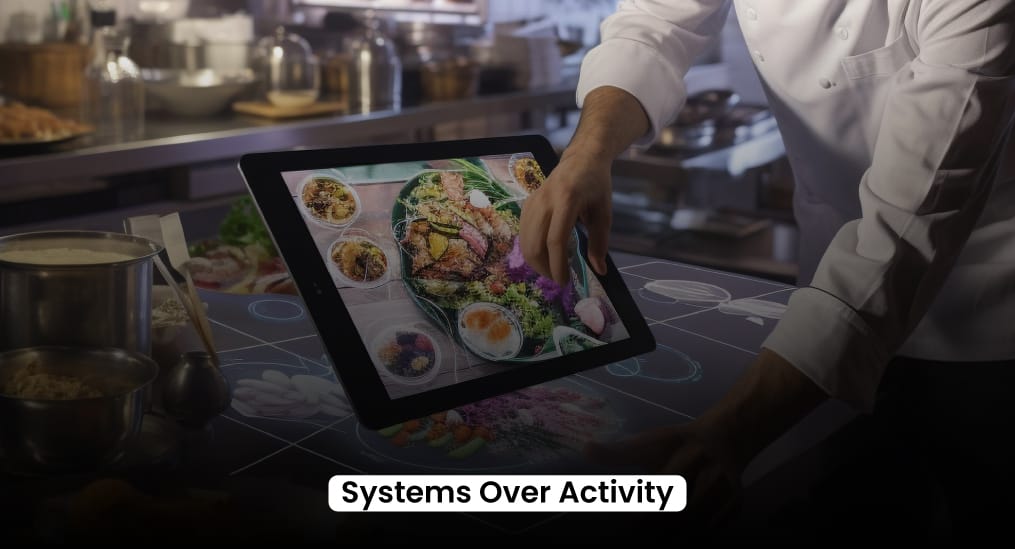
Catering Companies do not struggle because they lack visibility. They struggle because they lack structure.
Marketing activity without a conversion system leads to wasted effort. Automation, when applied correctly, does not replace human interaction. It organizes it.
The shift is simple but often overlooked. Stop measuring success by attention. Start measuring it by conversion.
Once that shift happens, the tools and strategies you choose will look very different, as explained in The Importance of Automation in Hospitality Marketing.


